If you were forwarded this email, Tundra Angels is an angel investor network that invests in high growth startups in the state of Wisconsin. We write this weekly newsletter to help individual investors glean from the lessons, stories, and insider tactics that power Tundra Angels’ investing success. Check us out here on our website.
Now, onto today’s post!

Defensibility Deprived
In June 2023, Sam Altman, CEO of OpenAI, responded to an audience question in a puzzling way. Asked if a group of Indian engineers could build foundational models with $10 million, Sam Altman responded, “It’s totally hopeless to compete with us on training foundation models, and you shouldn’t even try.” The video is embedded below.

My oh my. How much has changed in a little more than three years.
But Sam Altman had invested in companies such as AirBnB, Uber, Reddit, and Asana, among many others. Shouldn’t he understand defensibility!?.
But… based on this clip, three years ago, he saw actually saw OpenAI as impenetrable!??
I wonder what he would say now… Suffice to say, his answer has probably changed.
Why Defensibility Matters
Of things that Tundra Angels considers when evaluating startups for investment, one of the biggest factors in our decision relates to defensibility.
An individual at a recent pitch meeting echoed such a concern which I hear often from individual investors exploring the angel investing space. This individual said, “It feels like every other day there is a startup that gets crushed because an AI hyperscaler moves into a new category and kills a host of startups’ opportunities.”
In other words, this person rightfully brought up the threat that hyperscalers pose to a startup, and essentially asked, how can a startup become defensible?
Defensibility is not just important during growth, but it is why startup acquisition happens in the first place.
The intended outcome of any VC-backed startup is to get acquired, to create abundant business and societal value, and to realize a financial outcome for its stakeholders.
How does a startup increase its chances of an acquisition? Defensibility is one major answer. To frame defensibility, I’ll use the metaphor of a castle and a moat.

Bodiam Castle, Scotland
When an incumbent or other market actor meets a startup, the actor has two main options. Either, 1) Leave the startup alone and see what happens, which is the typical initial posture. Or, 2) Go into attack-mode and try to re-route the startup’s moat.
✅ The aim of the startup should be to become so defensible that a market actor would prefer to pick up the entire castle rather than re-route the moat. ✅
The aim for a startup founder is to make their startup so defensible that it triggers an acquisition rather than war. That is, become so defensible that the market actor would rather not spend the time and capital trying to re-route the startup’s moat, but prefer to just pick up the entire castle and acquire the company. Time and capital are the limitations of most opportunities or endeavors.
✅ The way Tundra Angels views it, startups that have strong defensibility asymmetrically increase their odds of winning in the market. Thus, they increase their odds of an acquisition. ✅
That’s why Tundra Angels, as an investor network, cares about defensibility - so that an incumbent would prefer to pick up the entire castle rather than re-route the moat.
Framing Defensibility
For a long time, I have wanted to write an article or series on the categories of defensibility and how I interpret them, but this is not that article. In the meantime, let me share a framework that has helped me think about defensibility at a high level. It’s from James Currier of the VC firm, NFX.
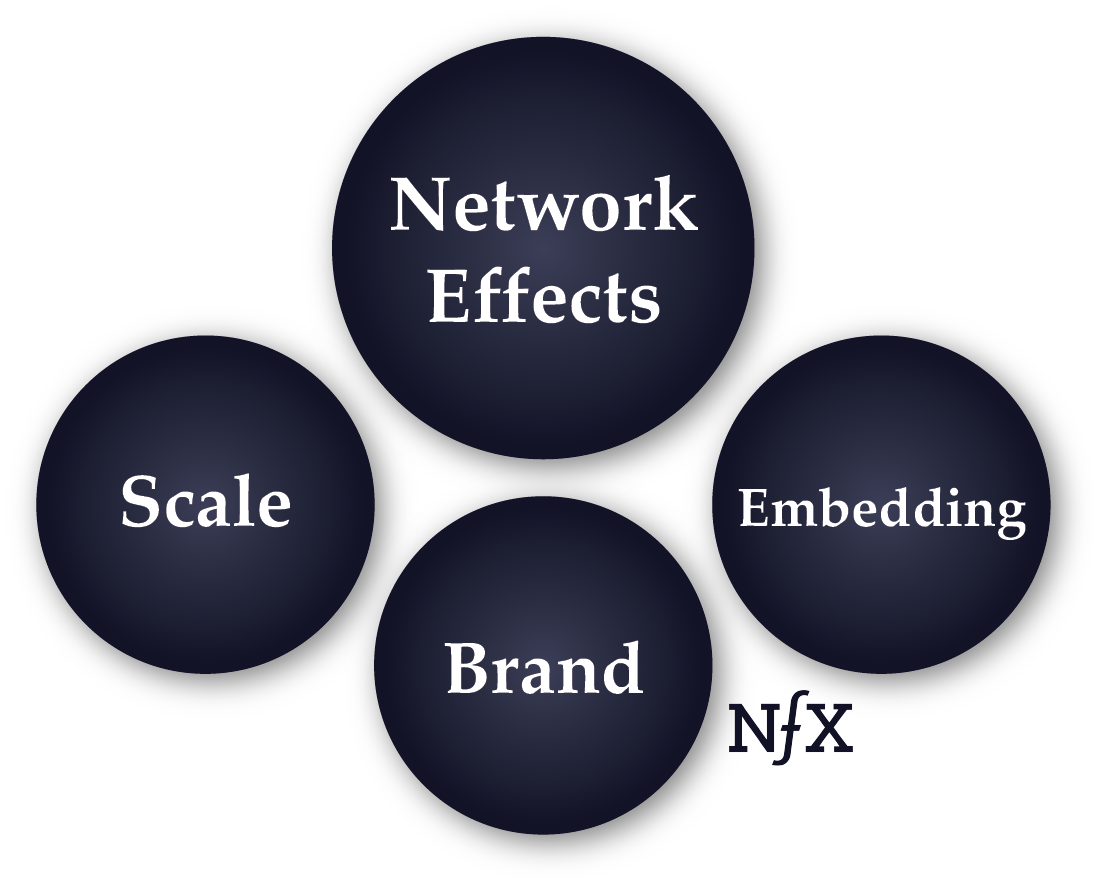
How We Prioritize Defensibility
To give you some examples, here are three examples of defensibility from the Tundra Angels’ portfolio.
COnovate, with Co-Founder and CEO, Dr. Carol Hirschmugl. COnovate is a material science startup that has developed a new nano-composite that can replace graphite in batteries and lead to a 6x better charging time and a 2x better capacity. COnovate has a full suite of patents and trade secrets, both in their process and insights, that create a moat of defensibility.
Cylerity with Co-Founder and CEO, Ryan Wheeler. Cylerity helps healthcare providers get paid faster. Their tech platform ingests Medicare, Medicaid, and commercial health insurance claim data, verifies the accuracy of the claims, and underwrites against the claims to advance working capital to the healthcare provider cash within 36 hours.
Cylerity has several defensible moats. One in particular is their business model and go-to-market strategy. Instead of selling to the end user, the healthcare firm who is needing the working capital, Cylerity instead goes upstream to the payment clearinghouses that process the river of $4.5 trillion of healthcare payments and becomes an embedded partner to them. With a new value-add tool in their sales bag, the clearing house then go to their end customers, the healthcare provider, to get them opt-in to the Cylerity solution. That is how the right business model can create defensibility in a market.
With this move to sell into clearing houses, Cylerity avoids the draconian sales cycles in healthcare. This, by the way, creates another defensible moat - Cylerity’s rapid tempo of customer acquisition.
EVEN with Founder and CEO, Mag Rodriguez. EVEN is a direct to fan platform where artists can pre-release their music 14 days out, 30 days out, etc ahead of going onto streaming platforms. Followers can buy their music and get exclusive access to content that they only put out on EVEN.
Network effects: One of EVEN’s defensible moats is network effects. As there are a finite number of artists, record labels, music distributors, all of which are rapidly moving onto EVEN because of how it gets artists paid nearly immediately without needing a global following.
Payouts take months but with EVEN it’s daily: This is a technological and a business model moat. The incumbents would have to re-write their entire business models if they were going to pay artists on their platform on a daily basis.
Access to fan data: This is a content and product moat. The incumbents would have to completely re-write their privacy policies and user agreements, as well as completely re-write their products to surface direct fan data to their artists.
With just these three examples, you can start to envision the defensibility at play that could cause an incumbent to just pick up the castle rather than re-route the moat.
Closing Thoughts
As Sam Altman displayed, no company, no matter how much talent or capital, is never impenetrable.
That’s why founders should be brutally honest of where you stand - is your startup a proverbial little hut in the countryside? Is it a tower without a moat, that needs to pay attention to defensibility? Or like Sam Altman, is what you think is your moat can be re-routed with a competitive maneuver? The goal should be for a startup to become a castles with deep and wide defensible moats.
✅ Defensibility matters because startups that have strong defensibility asymmetrically increase their odds of an acquisition.
Individual investors should look to invest in startups whose defensive moats are so strong that an incumbent should want to pick up that castle, rather than trying to re-route the moat. ✅
If you want to know how we evaluate that, let me know.
See you next Wednesday.
-Matthew
Here are some of the recent newsletter articles!


